

1031 Exchange Guide
A 1031 exchange, step by step.
The working guide
From closing table
to royalty check.
Our 1031 exchange overview explains why producing mineral and royalty interests can serve as like-kind replacement property. This page is the companion to it: the order of operations, who does what, and the dates that cannot move.
It is written for an owner who is selling, or about to sell, investment real estate and wants to understand what an exchange into minerals actually involves before committing. One rule shapes everything below: the exchange has to be set up before your sale closes, because once the proceeds reach you the opportunity to defer the gain is gone.

Before you start
Three things to have
before the sale closes.
Confirm your property qualifies
The property you are selling must be real property held for investment or business use, not a primary residence or a vacation home you use personally. Your tax advisor can confirm this quickly.
Line up your team
A qualified intermediary to hold the proceeds and paper the exchange, your tax advisor, and Heritage on the replacement side. If you do not have an intermediary, we can introduce you to several we have worked with.
Know your numbers
As a general rule, a full deferral means reinvesting all of the net proceeds into replacement property of equal or greater value. Any cash or debt relief you keep is usually taxable, so settle the target amount with your advisor early.
The eight steps
What happens,
in order.
- Step 1
Decide before you close
Tell your closing agent and tax advisor you intend to exchange while the sale is still under contract. Once proceeds are paid to you, the sale is a sale and the gain is due.
- Step 2
Engage a qualified intermediary
The intermediary prepares the exchange agreement and is assigned into your sale contract so the proceeds go to their escrow at closing, never to you.
- Step 3
Close on the property you are selling
This closing date is Day 0. The 45 day and 180 day clocks both start here, and they run at the same time, not one after the other.
- Step 4
Identify replacement minerals by Day 45
Deliver a signed, written identification to your intermediary. Most exchangers name up to three candidate properties. Heritage provides the legal descriptions you need.
- Step 5
Review the interest with Heritage
Walk through the prospectus, the title and production history, and the operator. Take the time you need here, the identification letter has already done its job.
- Step 6
Fund the purchase through the intermediary
You sign the purchase agreement, your intermediary wires the exchange funds, and Heritage conveys the interest to you by recorded mineral deed.
- Step 7
Close by Day 180
The exchange must be complete within 180 calendar days of your sale, or by the due date of that year’s tax return if it comes first. Extensions are rare.
- Step 8
Report it and start receiving income
Your tax advisor reports the exchange on IRS Form 8824 with your return. Heritage helps you get set up with the operator so royalty income is paid to you as production is sold.

The deadlines
Two dates to circle.
45days
to identify
Your written identification of replacement property must reach your qualified intermediary by midnight on the 45th calendar day after your sale closes.
180days
to close
The replacement minerals must be deeded to you within 180 calendar days of the same closing, or by your tax return due date for that year, whichever comes first.
-
Both clocks start on the day your relinquished property closes and run at the same time. The 180 days are not added after the 45.
-
The counts are calendar days, so weekends and holidays are included. If a deadline lands on a Saturday, it is still the deadline.
-
If your sale closes late in the year, the return due date can cut the 180 days short unless you file an extension. Raise this with your tax advisor early.
These are general IRS rules and deadlines, summarized here for orientation. They are not tax or legal advice. Work with a qualified intermediary and your own tax advisor before starting any exchange.
Common missteps
Where exchanges
go wrong.
Most failed exchanges come down to a handful of avoidable mistakes. None of them are complicated once you know to look for them.
Touching the proceeds
If sale proceeds are paid to you, even briefly, the exchange generally fails. The intermediary must be in place before closing so the funds go straight to escrow.
A late or vague identification
The 45 day letter has to be signed, in writing, and specific enough to describe the property. Verbal notice or a note to yourself does not count.
Identifying too narrowly
Naming a single property leaves no room if diligence turns something up. Most exchangers identify up to three candidates so there is a fallback inside the deadline.
Buying down
Replacement property worth less than what you sold, or leftover cash, is usually taxed as gain. Set the target amount with your advisor before you identify.
A different taxpayer on each side
The name or entity that sold should generally be the one that acquires. Changing title mid-exchange is a common way to lose the deferral.
If you are still weighing whether to exchange at all, selling outright and buying minerals directly are both simpler paths, and a self-directed IRA is another way to hold them. Heritage can walk through any of them with you.
Tell us where you are in your exchange
Frequently asked questions
1031 questions, answered.
A few of the most common ones. See the full list, grouped by topic, on our FAQ page.
Investor voices
What investor partners say.
“I've worked with Don and his team at Heritage Land & Minerals on over five mineral properties. I've continued investing with them and have enjoyed how easy and straightforward they have made the process.”
Names abbreviated at investor request. Past performance is not indicative of future results.
Confidential Prospectus
Heritage Land & Minerals
Prospectus
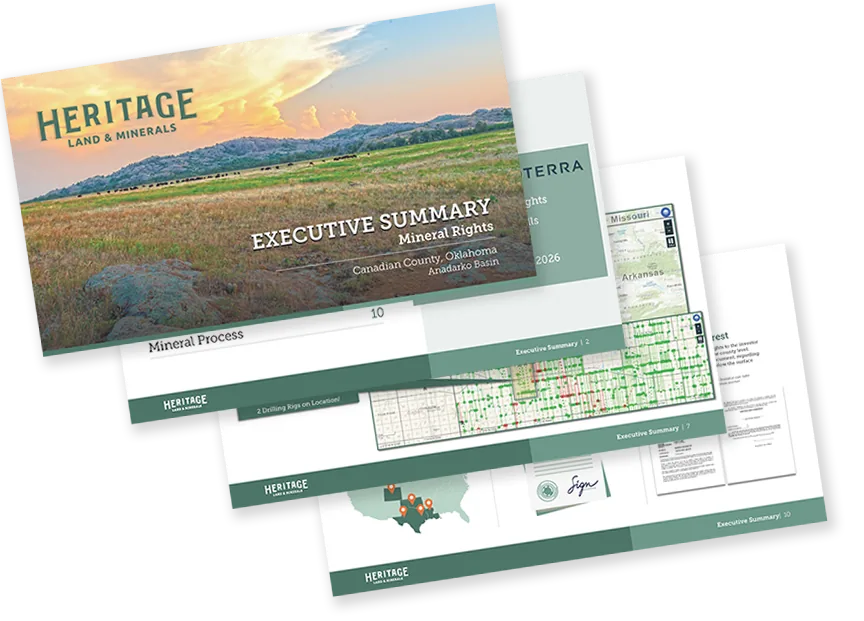
Current offerings, tax considerations, and a mineral acquisition overview.
- Current mineral and royalty offering details
- Why buy mineral rights, including tax benefits
- Location, well mapping, and surrounding production
- How purchasing works, step by step
1031 exchange clients receive this same prospectus. It covers the current offerings you can identify as replacement property.
 Request access below
Start your 1031 exchange
Selling investment property? Tell us where you are in the process and we will send the prospectus and walk through the timeline with you.
Risk disclosure
Mineral and royalty investments involve substantial risk, including the loss of principal. Distributions depend on production volumes, commodity prices, operator performance, and other factors outside Heritage's control, and are not guaranteed. Mineral and royalty interests are illiquid; there is no public market for them, and resale, including its price and timing, is not guaranteed. Heritage Land & Minerals offerings are available only to accredited investors and only by means of a confidential prospectus that contains the complete risk disclosure. This website is not an offer to sell or a solicitation of an offer to buy any security.